


 Fire safety of foam pits in France
Fire safety standards in France are very strict. How can a trampoline park foam pit be made compliant?
France is known for its fire safety regulations in public-access buildings (ERP). Leisure equipment (playgrounds, trampoline parks, climbing walls, etc.) is considered large furniture and must meet the requirements of Article AM15 of the decree of June 25, 1980, regarding safety regulations against fire and panic risks in ERP. The SDIS – Departmental Fire and Rescue Services (the fire department) thus require that this indoor equipment be composed of materials rated at least M3, or a classification equivalent to or higher than Euroclass category D s3 d1 according to the NF EN 13501-1 standard.
However, the foam used in foam pits does not have a sufficient rating. Usually made from polyether—a material primarily used for bedding mattresses—foam pit foam is at most rated M4, or even unrated (or Euroclass E). It therefore does not meet French requirements.
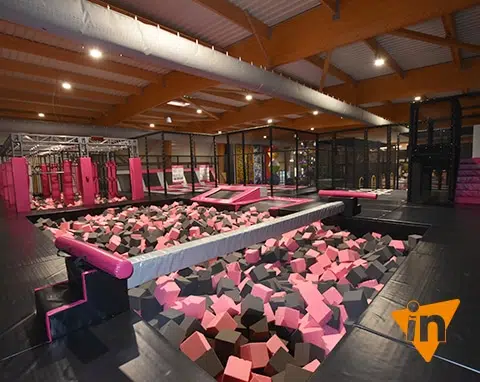
Yet, it is currently the only material that provides acceptable cushioning for jumps from trampolines or platforms. Foam blocks, generally 20 cm cubes placed randomly in a pit, combined with the air pockets between them, create a cushioning surface that allows for landings from falls of several meters. These air pockets are essential, which is why the blocks must be regularly stirred and decompressed to prevent them from forming a compact mat.
Denser, harder materials that could be rated M3 would not provide enough cushioning and could cause injuries. Some manufacturers have tried coating foam blocks, but they become too hard or cause friction burns. Plastic ball pits do not properly stop falls either; the balls move aside, and jumpers can easily hit the bottom of the pit, which is unacceptable. Americans, who have used foam pits for over 20 years, continue to use polyether foam blocks.
A foam pit is, however, an essential activity for trampoline parks: it allows for practicing and mastering simple acrobatic tricks. If the jumper misses, it is better to land flat in foam than between two trampoline beds. Note that a trampoline park is not a gymnastics club; technical or complicated acrobatics such as triple flips must be prohibited. The pit must be constantly supervised by at least one employee to ensure that jumpers stay within their skill limits.
It is therefore currently impossible to find materials that comply with fire standards while ensuring safe landings for players. An alternative approach to fire risk must therefore be proposed to the French fire services:
- firstly, there must be no heat source under or near the pit: no electrical cables, no motors, no heating… Proximity to a kitchen should also be avoided, or a fire wall should be placed between the risk zone and the foam pit. There is therefore no reason for a fire to start in a pit.
- the capacity of a pit is very low, limited to the capacity of the equipment (beds, platform, beam, etc.): when a player falls into the pit, they must exit before another player begins. In the event of a fire, the pit will be evacuated very quickly.
- the foam pit is constantly supervised by park employees. If an evacuation is necessary, the employee can assist a player in exiting the pit and ensure that no players remain inside.
The fire risk is therefore extremely limited, and fire services usually share this analysis. However, since Article AM15 is not met, it is preferable to propose a compensatory measure such as placing a fire extinguisher near each foam pit. This extinguisher must, of course, be placed so as not to create a risk of impact or injury to players. A corner within the safety netting can be a good location. Possibly, a cushioned wrap around the extinguisher will ensure player safety.
Play In Business has thus been able to install foam pits in most of its trampoline parks, with a high level of safety and the approval of the fire services.